Saturday, August 9, 2014

Feed Me (aka the cultural lunch)

This post is going to be about the cultural meal we had today.  If you are a vegetarian or you don't want kids to know about this then DON'T READ IT!!!! I'm not going into gory details (ok maybe just a little bit) but I don't want anybody to be upset or freaked out by what I'm going to to say.  Decide now if you want to read it....


       Ok I'm guessing you're with me and that you want to know more.  Today we had a cultural lunch where each of the different regions made food.  Yesterday chickens and goats were brought and today we slaughtered them.  First the goat was killed.  I thought it was just going to be a quick slice across the throat to kill it, but this was not the case.  One of the trainers stabbed it in the neck and left the knife in.  Others held it's legs so that the goat couldn't move.  As the goat slowly, yes it was slow, died its tail would twitch occasionally or it's legs would move. I'm told this happens because the muscles aren't getting any air.I had a hard time watching this. I thought that I could watch and be fine, but when it started twitching and the death wasn't instantaneous I had to look away. And unfortunately it looked similar to one of my pet goats back home.  So once the goat was killed people began to skin and gut it. 
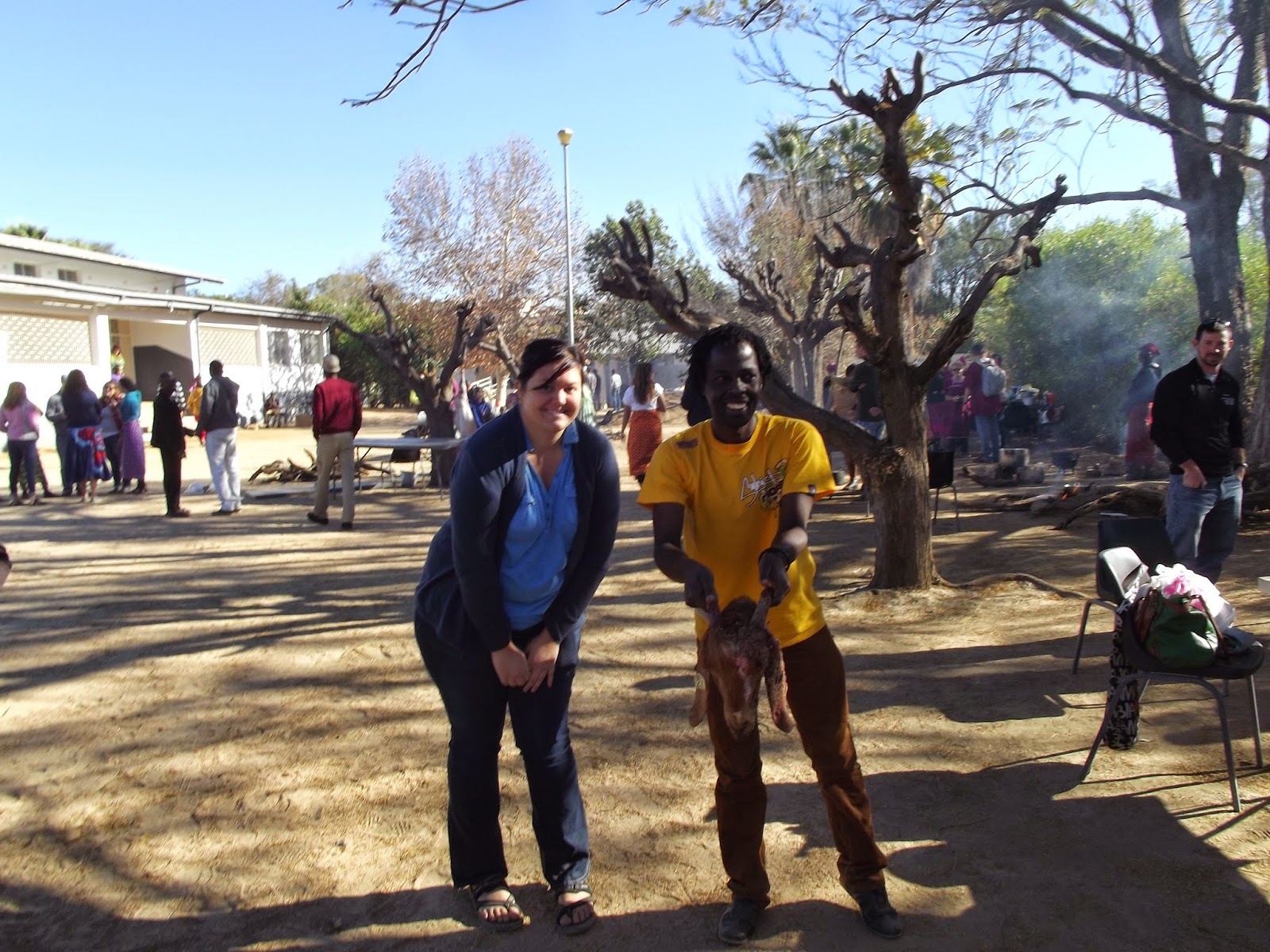
        Since I'm learning Otjiherero I consider myself to be part of the Herero tribe (ish).  So I quickly found out that Herero's eat really weird foods.  We were given cow intestines, the goats lungs, liver, heart and intestines.  The first thing cooked was the tripe.  It was thrown in a pot and then placed over a fire to cook.  Then we moved on to cooking the rest.  In order to make the goat intestines edible the poop had to be removed first.  Someone took a knife and just kind of cut it out.  This was also thrown into a pot to cook.  The strangest part that we cooked of the goat was the actual head.  Cooking goat head is considered a delicacy and the meal is called smiley.  This is because when the goat head is cooked the lips pull back and it looks like it is smiling.  People eat everything on the head, but the cheek meat is considered to be the best.  The head was wrapped in tin foil and placed in the fire.  The last thing that my tribe made was bread.  It was made by hand.  Most of the ingredients used are the same in the states, however they add cow fat to the bread.  The dough was placed in a pot and left in the sun so that it could rise.  Once this was done, the pot was placed on coals, and coals were placed on top of the pot as well.  People also killed  chickens.  Now I have definitely heard the expression "running around like a chicken with its head cut off", but it is a completely different thing to actually witness that.  The chicken would be flapping its wings and trying to run around...without a head.  
     Each of the regions made slightly different foods.  The Zambezi region (speaking Silozi) made a lot of fish and pumpkin.  The Wambo region (speaking Oshiwaynama and Oshidonga) made chicken.  The KKG group ( the click language) made pigs feet and a lot of pork.  The Africaans group made chicken, beef and fat cakes.  Fat cakes are like donuts, but much more filling and less sugary. I forgot what the Rukwangali group made, I think it made chicken.   Each of the regions had their own breads.  My favorite bread was definitely the Herero bread because it was really soft and you could easily tear it apart with your hands.  I tried some Smiley and it wasn't too bad.  It definitely tasted like goat and it was a little slimy but it was good.  The one Herero food I didn't eat was their sour milk.  They enjoy drinking milk that has started to curdle, and they might even squeeze some lemon into it.  That is something I don't think I'll ever try.  One of the regions made the mopane worm.  The mopane worm is a caterpillar like grub and most of southern africa eats it. I had my first one when I was in Botswana 2 years ago and that one was more than enough for me. 
Girls in traditional Rukwangali cloth
Girls in traditional Silozi cloth

Girls in traditional Oshi dresses with their teacher.  The men wore shirts with similar material

The pots used to cook everything

Cutting up tripe to be cooked

Holding a goats head with my language teacher

My friend in a traditional Herero dress. Usually you wear 6 layers underneath, but she's only wearing 2.

Wednesday, August 6, 2014

Chicken and Carrots (aka it's been 2 weeks)

      I've been in Namibia for 2 weeks and honestly it feels like its been longer.  I've have fallen into a pattern.  I wake up around 6:30 get dressed, put on my face (make up), pack my bag, grab a banana for breakfast, lock my room and lock the house when I leave. By 7 am I'm at the graveyard waiting for the rest of my group to come and then we walk around 20 minutes to training.  Training generally starts at 8 and goes until 4:30.  We have language training in the morning until tea time and then sessions as a group in the afternoon.  Then I walk back to my house where I settle down for the evening.  My meals are generally a piece of fruit for breakfast since I'm not much of a morning person but I need to eat something I suppose, last nights leftovers for lunch, and a heaping plate of food for dinner.  Dinner is always already made and on a plate waiting for me by the time I get back to my place around 5 pm.  Most of the family has already eaten and I'll usually eat around 5:30 6 ish.
     Dinner is generally rice with sauce, some form of meat (not chicken)and a tiny amount of vegetables (usually potatoes, carrots, squash or beets).  I have no idea what type of meat I've been eating.  I hope it's either beef or pork but you don't really know.  Game meat (wild boar and what not) has a very distinctive taste to it, so I can almost always narrow it down to either beef, pork or game meat.  I have only had chicken twice since getting to Namibia.  Chicken is really expensive here so it's not usually made for dinner. Chicken was for dinner last night and my eyes legitimately closed with each bite because it was so good.  I'm really glad that no one was eating with me or else I would've received some really weird faces.  I am really starting to miss fresh veggies.  We eat potatoes a lot but I really miss salads and celery.  Rather I really miss any green veggies and tomatoes.  The juice here is awesome though.  It is so  fresh that you have to use it within 5 days of opening it.
     I have been wearing the same pair of shoes everyday.  They're Keens and they're amazing.  They're closed  toe but not like sneakers.  The front consists mainly of straps, so for people like me who love flip flops but aren't allowed to wear them they're perfect.  They are also dust colored which is perfect.  I walk through so much sand everyday that clumps of it form dirt in my shoes.  I get so much sand on my feet but that is to be expected.
      In training we started the technical aspect of it.  So for me that means teaching training.  There are 32 of us education volunteers.  We started first by looking at a syllabus for math grades 5-7.  Then we created our own year plans based on that syllabus.  Schools here function on trimesters so we broke up the year plan into three parts.  From there we narrowed our focus to create a scheme of work.  A scheme of work outlines all the topics that will be covered in each week and how long you think each will take.  Lastly we used that to create a single lesson plan.  It was really hard to create a year plan because I wanted the order of topics to make sense and I wasn't sure if my order actually made sense to anyone besides me.  These sessions were really boring but really informative so overall I think the sessions were very useful.
     Today went and observed high school classes.  In the classroom I was in each wall was written on.  Each student had their own desk and chair but not everyone had paper.  Since it was the end of the term the teacher just kind of taught whatever they wanted. The purpose wasn't to teach the kids anything new, it was for the volunteers to experience a class.  The kids in my class were really rambunctious. They didn't necessarily misbehave they just had a hard time paying attention. They had a volunteer who had been in Namibia teaching for a while teaching a lesson.  It was really interesting seeing his style and I definitely took notes.  From the second he walked into the classroom he demanded the kids attention and he dominated the room.  He had the kind of presence that forced the kids to respect him and pay attention (most of the time).
     I know a lot of you are wondering how proficient I am in my language. Well, I'm going to type the next paragraph in my language.  Then I will translate it for you and you can judge my language skills for yourself.
           Ene randje owami Lynn.  Mba za ko America mo Connecticut.  Mbina ozombura vivari nbari. Owami omuriyandjere morupa romahongero.  Me kara ozombur mbari muno.  Mbi kara mo Okahandja. Ami me suvera okupuratena ko mzumbi. Me vanga okurihonga Otjiherero.Mbi nomuzandu.  Mbe mu suvera tjinene.
           My name is Lynn. I am from America in Connecticut. I am 22 years old. I am a volunteer in the education department. I will be staying for 2 years.  I stay in Okahandja.  I like to listen to music.  I want to learn Otjiherero.  I have a boyfriend. I love him very much.
    I could go on to say things about other people and use different tenses but you get the message.  Right now I can really only do simple sentences. We just worked on likes/dislikes and we have worked on possessives like my book and his bread.  I have flash cards for nouns and a list for verbs. I should study more than I do.

Sunday, August 3, 2014

Cell phones and meat (aka a trip to Windhoek)

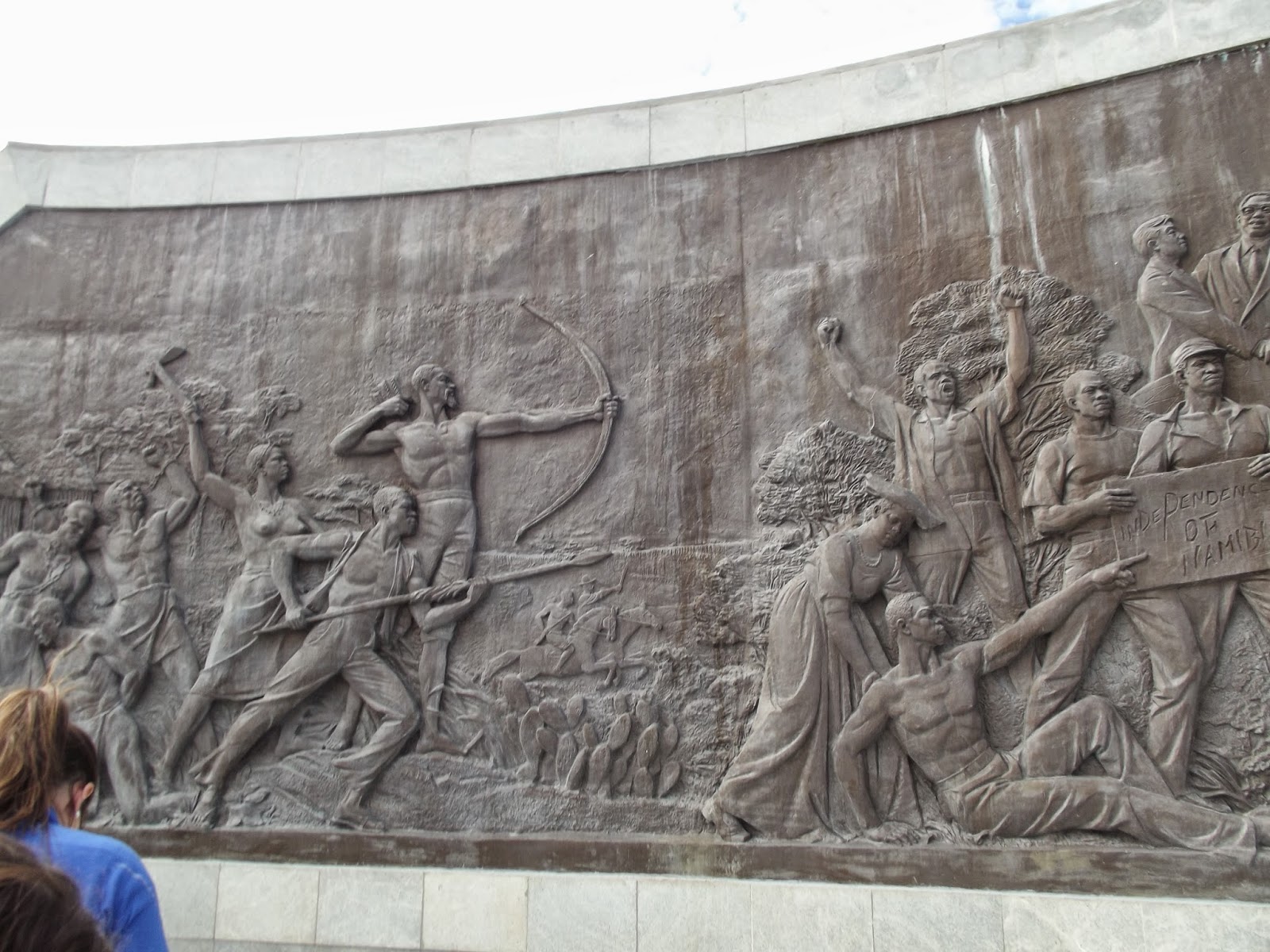
          Yesterday we took a trip to Windhoek, the capitol of Namibia.  We first went to the Heroes Acre which honors the people who died fighting for Namibia's freedom.  The monument was really cool.  We got a little tour about it and learned some cool facts like all the materials that made up the monument come from Namibia and none of them were imported.  Or that there are 174 graves with only a few of them being either real or symbolic graves.    The back panel portrays the story of Namibia's struggle for independence ending with them carrying a flag in freedom.  On either side of the steps leading up to the monument are graves that hold peoples names. This monument went up in 2002 and the first person to be buried there died 13 days after inauguration of the monument.
         After this we divided our group and went to 2 separate malls.  Most of the people myself included used this time to buy a phone.  I got the cheapest phone there was which cost me $169 Namibian Dollars o r rather $17 US Dollars.  I'm really just using this cheap thing to talk to my fellow Namibians. I've been using imessage and facetime to talk to my people back home and it's been working pretty well.  When we were at the mall I was reminded of my time in Namibia for there were places like Mugg and Bean, and a pizza place that we used to go to all the time.  It was interesting seeing the different types of stores that exist here and not in Botswana.
      We continued our journey to a market place located at Singles Quarter.  Apparently  this where all the single men used to live but nowadays anyone can live there.  The market place was small and most people sold apples and other fruits and vegetables.  There was a section where you could buy a slab of raw meat.  They didn't really advertised what type of meat but some looked like cow.  Then there was a place where people were cooking meat on a grill.  You could grab a sample of the meat and if you liked it you could give the chef some money and he'd give you meat in a newspaper.
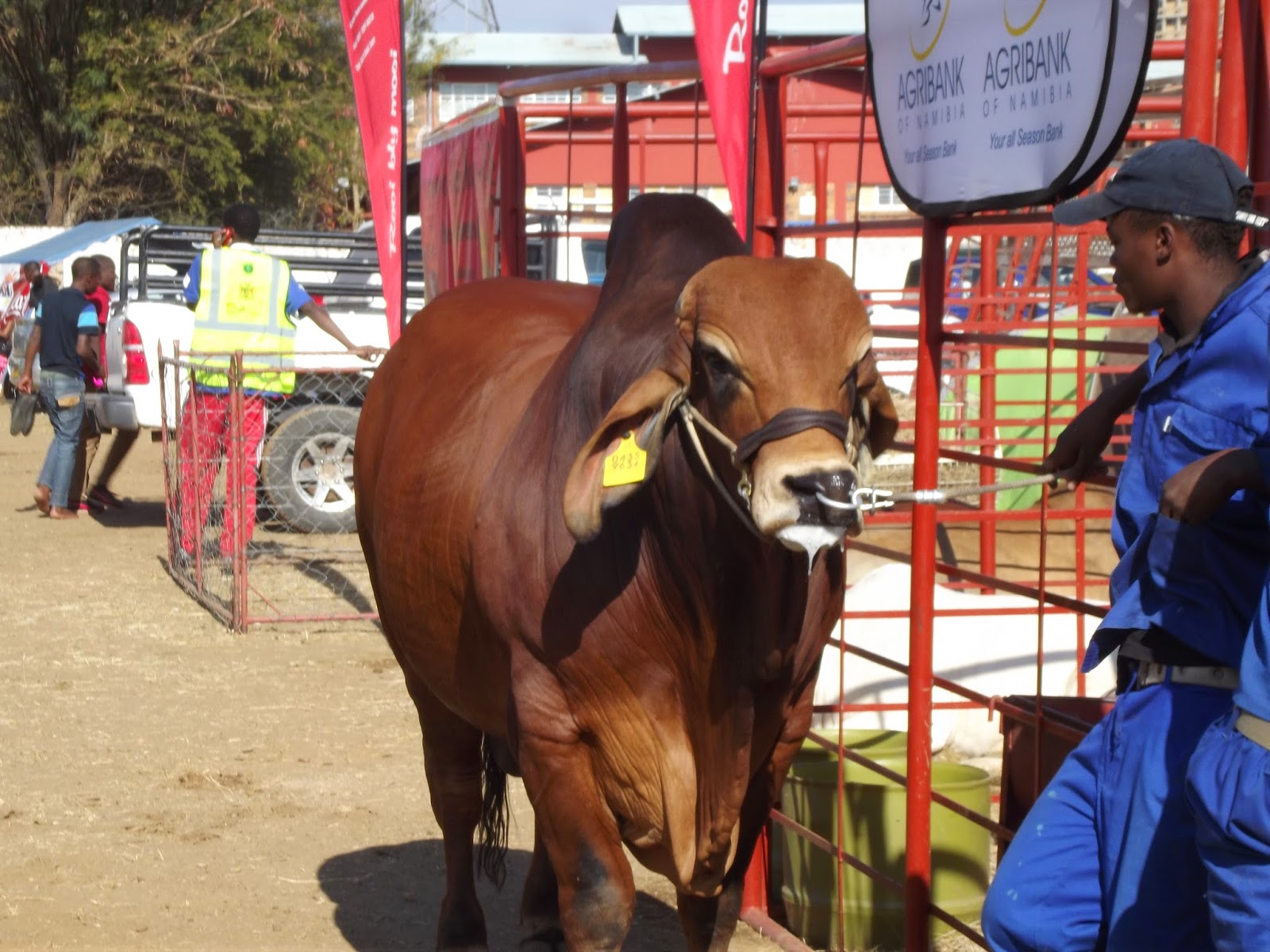
    The last thing we did in Windhoek was go to an expo.  Most people in tents around the rims were selling meat, sodas, and icecream.  There was a cattle auction going on in the middle and off to the sides were different types of livestock like goats and sheep.  There was a big tent next to the auction where you could buy clothing and other things.  Outside there were also some inflatables for the kids to play on.
    Below are some pictures from the trip.  I don't have any pictures of the market place because I was told to leave everything on the bus.


Friday, August 1, 2014

An Intense day (aka the history of Namibia)

         Today was a rough day, for multiple reasons.  I've been learning my language in leaps and bounds so it's only natural that I hit a rough day.  We started learning about the irregular verbs and how to conjugate them.  Not only that but we started forming our own sentences using multiple tenses.  Otjiherero has 1 past tense, 1 present, and 2 future. Or at least those are the tenses I know. Anyways you only use the present tense if you are habitually in that state. For example if you are married you'd use the present tense. if you were currently in the process of drinking water you wouldn't use the present tense unless you were doing it everyday without breaking to do anything else. What you WOULD use to say i'm drinking water is the future tense. I like to think of it kind as I will continue to do this, as in the immediate future.  Then I think the other future tense is for if you are going to do something in a days. Of course this is my understanding of the language thus far.  I struggled conjugating the verb the right way and using the right prefix. However, I look over my notes every night so hopefully I'll understand it a little better looking at it on my own.
     In the afternoon we started with a diversity walk to show what kind of diversity we had in our training group.  Then we got a crash course on the history of Namibia.  First we learned about all the different tribes and how they function. It was cool hearing about how some tribes have a king and how that king would interact with the President of Namibia.  We also heard about the regions that each of these tribes were in and the reasoning behind their clothing.  Then we did an activity where each group got a passage about the apartheid.  Our group had a passage about the German administration.  It talked about how the Africans weren't allowed to own cattle and in order to avoid the very strict laws against them they would run away from their farms to either try to live off the land or into town to get a job.  Then diamonds were discovered and the Germans struggled to find a work force to create the railroads that would connect the diamond mines.  So they began to use migrant workers and even pulled people from South Africa to work for them.  Then the German force created a deal with local village chiefs that would provide a work force of natives in exchange for presents from the Germans.  Once this was done we watched a video about the genocide in Namibia.
    I have never learned that the first concentration and deaths camps were in Namibia years before Hitler came to power.  After Germany gained control of Namibia they decided to try and colonize the country because Germany was running out of space for its people.  They came to Namibia and at first things were ok. Soon though, a rift was created between the two people who inhabited this land and the Germans began to degrade the natives.  Then it became more extreme.  The Germans would rape the women and kill.  So one of the tribes the Herero's decided to fight back.  And that's when it began. I don't remember a lot that happened before this next event but it was pretty much a one sided war.  The Herero withdrew and hid out at a watering hole hoping that negotiations would soon be coming.  The German force then attacked the Hereros and chased into the Kalahari desert. Once the people were in the desert a barbed fence was placed around the people so that they couldn't escape.  Many died then.  The Germans then built concentration camps and rounded up all the Herero's and brought them to the camps.  I think you all know what happens at a concentration camp so I won't go into that. Another tribe, the Nam ( I think...) heard of the Herero's pain and decided to fight back as well.  This landed them in the first death camp on an island that is now ironically a camping site.  This lasted until early 1900's (1909 I think). In 2004 a German Representative came to Namibia to apologize for what happened and to acknowledge that some of the events (not all of them ) were in fact genocide. I'm pretty sure that is an issue that is still being delegated to this day.
    I was surprised not to hear of this.  Even more that one of the major riots took place in Okahandja ( where I'm staying at). I hate to be one of those people who get's all offended without knowing all the facts but still.  This shouldn't have happened, and I can't believe I haven't heard of this until now.

Tuesday, July 29, 2014

Last Day of Camp ( aka moving into host families)

        Yesterday we found out the language that we would learn.  We were each given a piece of paper with our name on it and an animal.  Then we were told to make that noise and find other people making the same noise.  Then we found our teacher.  My animal was a jackal, and making a noise for this was a little hard.  I found 3 other people making the same noise. Our teachers name is Ramsey and we are learning Otjiherero.  Otjiherero is spoken pretty much through the entire country.  For some people their language is only spoken in one region so they pretty much know where they're going to be. But for me I could literally be anywhere. Today we had our first language class. We started off learning about possible consonant and vowel combinations.  This language has single sounds like A (ah), E (hay without h), I (ee), O (oh), U (You without y).  Then there are consonant and vowel combinations like  ta (tah),and  me(may).Then there are double consonant and vowel sounds like nwa (the n is a short sound not fully prounced) and vye (v ay).  THEN there are triple consonant and vowels like mbwa (the m and b aren't as prounced) and tjwe (the tj makes a sh sound like she). Getting my mouth to form some of these sounds was really hard.  We also learned greetings. If you want to say to someone or ask them how they are you could say Kora which means what's up.  The person could respond with Nawa which means good.
           In the evening we got to meet a member of our host family.  We were given a slip of paper with a name on it.  Then after a session about the expectations and what not for host families we stood up and one at a time say the name of our family member.I'm living with the Hijarunguru family. My family consists of Belinda (the mom), Judu (the son) and Tukoo (the sister).  Belinda is a single mom living with her 13 year old son and her sister. She teaches English and on the weekends makes her perfume.  They live in town so I will be walking to training everyday.  It will probably be a 25 minute walk. Thankfully the first morning we will be picked up at a central location.  The house that I'm staying at is a 1 story cement house.  When you first enter through the gate there are 2 houses and the one I'm in is the 2nd one.  You enter right into the kitchen.  The house has everything, running water, electricity, and internet (which is how I'm typing this now).  I am required to have my own bedroom (not my choice, it is a peace corps. requirement).  It's a simple room but very pretty. The bed has orange sheets, there is a closet and a dresser.  Another requirement from the Peace Corps. is that my room is able to be locked.  If the house doesn't have a lock on the door, or it's broken the Peace Corps. will provide a new lock. All the volunteers were placed in either town (like me) Smarties(see previous post), Vedersdale(the town that I thought began with F...again, see previous post), Nau-Aib (previous post), and Nieb ( which just got added.)  Everyone not living in town will be driven to the training site, so I'll get plenty of exercise walking everyday.  Housing a Peace Corps. is considered an honor and to make sure that the families can support us they are given gift cards to multiple grocery stores.  We will have 2 meals a day with our families (breakfast and dinner) and lunch is during training so it's on our own.  We were given money so that we could actually buy food.  Dinner was a bit awkward. My family dinners are always very loud and full of discussion.  This dinner was quiet but then again there was only 3 of us and I'm brand new.  I wish I had a little bit of warning because I was about to eat before she mentioned saying grace.
       I figured I'd say something about the food here. So far it's been a  form of meat (if you ask the type they won't usually answer until after dinner), rice, and some form of vegetables.  Apparently I've eaten antelope one day, beef, liver, and even chicken one day! But most of the time the locals don't know what type of meat they are actually cooking.  I've noticed that the game meat (antelope and really anything not beef) has a very distinctive taste and my stomach isn't really sure if it likes it or not.  The juice here is amazing, or so I think so.  It is very sweet and very rich in flavor. One of my favorites is guava juice.


Saturday, July 26, 2014

Quirks are only Quirks to other Quirks...aka the first few days

                To start this off right I am going to begin with the staging.  On Monday I flew from Hartford to Philadelphia on a tiny 8 row plane. Once I got there I got to meet everyone.  There are 49 of us, and we are all either math/science education volunteers or business volunteers.  Most of us are education though. Everyone is so nice.  The average age of a peace corps volunteer is 28 but most people in our group are younger.  Everyone is really nice and we all get along really well.  At the hotel we signed in and had sessions about security and what not from 2-7.  Then we were dismissed until the time when we had to leave the hotel.  So a few of us got dinner at a sea food restaurant and went to target to pick up some last minute items (for me it was deodorant...apparently it was suggested to pack 6 packs but I only had 1).  Then most people tried to get some sleep until the 2:00 am check out.  So everyone including me got around 2 hours of sleep.  We piled onto 2 buses and drove to JFK airport in New York City.
               Once there we had 2 hours until we could check in for our flight. So since it was 5 in the morning I took a nice but comfortable nap in the airport surrounded by our suitcases.  Finally we were able to check in at 7 am, but then we had an additional 4 hours until our flight boarded.  So yet again we just hung around. I bought some motion sickness medicine and fuzzy socks since I forgot to pack both of those things.  Then we boarded our plane for an excruciating 14 and 1/2 hour flight.  Dramamine puts me to sleep so I managed to watch 1/2 of a movie before sleep claimed me.  Then I would wake up, watch a little more of the movie, read a bit, eat, and sleep yet again.  This process was repeated for quite some time.  We got 2 meals, which I feel is not enough considering we were on there for nearly 15 hours, but the flight attendants would give you snacks if you went to the back and asked for some.  Then we landed in Johannesburg South Africa and had a 5 hour layover until our last flight to Windhoek Namibia.  Once we landed in Namibia there were people who greeted us from the peace corps that also helped us collect our baggage. The media was also there.  5 people including myself were selected as potential spokes people and we went out first and got interviewed by a newspaper.  Then we took a group photo.  We then got onto another bus for 1 and 1/2 hours that took us to our training site in Okahandja.  In case you didn't keep track of all the hours that was 29 hours of travel (including layovers and waiting time).
        Namibia is very dry and desert like.  There are a few trees here but again their not very green.  Of course that might also be because it is winter here.  We're staying at a hostel that is 10 minutes away from the training site.I am in a room with 6 other girls.  The entire bottom floor is all girls and there is one common bathroom.  The water is always hot when you want it and it felt so nice to take a shower after all the traveling.  We have breakfast lunch and dinner in the dinning hall so far but that will change come Tuesday.  There are other people staying at the hostel so it isn't all Peace Corps.   Training has been from 8-5 generally so far.  We've covered a lot of introductions and sessions including security and expectations.
        Yesterday (Friday) we began the process of choosing our site. The leaders of the education committee put up descriptions of each site. Things that were included in this description was the grade range, the subject preferred, number of teachers and learners, if it was urban or rural, the type of housing the volunteer would stay at, and the secondary project they would like.  The secondary project is something the school would like to have work done on while the volunteer is there in addition to the volunteer's original work.
        The sites I'm interested in are in urban settings.  I chose this because I've never taught in a city and I would like to experience that.  I also choose sites that were generally grades 8-10.  I like working with older kids so I didn't choose many sites with  grades 5-7.  I also liked the sites that had a library listed as a secondary project.  So we were asked to choose 3 sites and talk about why we wanted them in our interview.
       Today (Saturday) we took a tour of the surrounding cities, that our host homes will be in.  We don't know who we are staying with yet, but we find out on Monday.  We stay with our host families for the remaining of training which is around 8 weeks.  The goal of being in host homes is to integrate into the culture and to practice our language skills.  I'm a bit nervous for this just because I don't know what they'll be like or if they'll like me. There are 4 main areas around our training site and there is an interesting history behind them all that I will try to explain.  The first village was called Smarties (yes that's right, just like the language).  In history this is where the richer white people would live.


 Then there was Nau-Aib (pronounced No Ape) where the blacks where placed.  This was definitely not as nice as Smarties.

  Then there is the 3rd village that begins with F that I  forgot the name of.


The last village Extension 6 is 2 years old and is still being worked on today.

 I was told that the divide between the villages today isn't nearly as visible but it's still there.
    On Monday we also find out what language we'll be learning.  There are around 7 languages and we'll be taught in one.  The language you are taught depends on your site placement.  Generally the language you learn is the one that is spoken there but that isn't always the case.  I am really interested in learning Afrikaans.  This is the language that most of us will be learning.  I feel that this language would be a little easier for me to learn just because it has a strong German influence. It is also spoken in South Africa.  Now I know the question everyone wants to know is if I could learn the click language. Well. Khoekhoe (pronounced kway kway) is the only click language.  The language isn't all clicks.  It's use is closer to the use of an umlaut in German. It's only used in some words. The whole language is not in fact just clicks. I've been told there are 4 clicks that are used.  All clicks include the tongue and different parts of the mouth.  
     Now I'm going to include some more random pictures of my time here so far. This is a picture of some of the trainers singing to us .


Above is my bed in it's mosquito net...Haven't seen a mosquito yet. Underneath that is some of the girls of the group having a jam session.
This is me and one of my friends Rachel on a tour of the vilages.

Monday, June 9, 2014

FAQ: Pre-departure

So I've haven't left yet but I decided I would start blogging anyways. A lot of people have been curious in my decision to join and how I have been feeling. This will hopefully answer some questions.

Q: Where are you going?
             I am going to Namibia. It is right above South Africa and is to the left of Botswana.  It is a fairly new country. It was occupied first by Germany and then by South Africa. It gained its independence from South Africa in 1990.  The capital is Windhoek.  The country speaks English but also different languages depending on the region.

Q: When do you leave?
            I leave for my Pre-departure training on July 21. I will travel to a location in the states (unknown) to meet my other volunteers and undergo some training like stuff. Then on July 22 all of us will fly out to Namibia as a group. Once there we travel to the actual training.

Q: How long will you be gone?
           The in country training will last 3 months long near the capital. Then I will be placed in a region  to begin the real work. I will be in that location for 2 years. So I will be in Namibia for 27 months total.

Q: What will you be doing?
            I will be teaching high school Math. High school to them is 8th grade through 12th grade. Now I know this is confusing. "You decided not to teach and now you're going to be teaching for 2 years??" Yes, I don't want to teach...in the States. I want to teach people who want to learn and who don't take education for granted. The education system in the States is flawed and I don't think I could be silent and endure it. As a Peace Corps. volunteer I will be teaching people who want to be there and who want to learn. Don't get me wrong, I do have a passion to teach, just not in the U.S.A.

Q: When did you decide to join?
               I never really thought about it until I studied abroad in Botswana during Spring 2012. At the end of my semester one of my friends and I had been discussing what we would do once we graduated. She brought up the idea of joining the Peace Corps. I had heard about it but didn't really know what it was all about. It was kind of in the back of my mind until I started looking at graduate schools to go to after I graduated from UNCC. While looking at grad schools I saw that the peace corps. had a program where you could study at a grad school for about a year and a half and then earn some credits serving as a volunteer.  It sounded perfect for me because at the time I considered getting a masters in TESL ( I was still in the education program). BUT then I decided i didn't want to teach anymore so I stopped considering grad school. So while looking for a job and posting on online job boards I looked into the Peace Corps. some more and decided it sounded amazing. So i started the extensive paperwork mid October of this year (2014...come on you should know what year it is).

Q: Why did you decide to join?
              I have traveled all my life and I love it. I know I'm ignorant of the world and I want to learn more.  I grew to love Africa (at the least the parts I have been to) and longed to go back.  As a white upper middle class female I have never experienced hardship in my life. Sure I struggled with deciding what to major in and sometimes I ate ramen for a week straight but that is nothing compared to what some people have gone through. I feel responsible. I came from a privileged life I feel that I need to make up for that. If someone can do something to help the world,even in the slightest, they have the obligation to do it!  So. what do you get when you mix a love of traveling, the yearning to learn more about the world, and the feeling of obligation to help people?  You get the Peace Corps.

Q: Are you excited?
           This is by far the most popular question I get asked. The answer is...YES! I am very excited. I am eager to begin what will probably be the most significant journey I will experience in my life.  I can't wait for all the people I will meet and all the things I will do.  I loved my time in Botswana and I am interested in seeing its neighboring country.  

Q: Are you nervous?
         I was surprised at how little people ask me this so it's not technically a FAQ but I will answer it anyways. I am very nervous. I went to school in North Carolina so I am used to being unable to going home for the weekend whenever I want. Then I spent 4 months in Botswana so I am familiar with home sickness and feeling disconnected from my friends and family.  But I have never been this far from home for this long.  I may not have running water or electricity depending on where I am.  Sure I said I could deal with it, but in reality I have no idea how I would cope in a situation like that. I'm not even sure if I will last through the training. There are a bunch of people who will make it feel like my heart has been ripped in two and I have no idea how I will react to being so far away from them. I can only hope that I am tough enough to undergo the initial shock of being so far away and tough enough to undergo being in an unfamiliar place for 27 months.